

Most Sydney trade businesses check the same number every morning. They open Google Ads, look at the click-through rate, feel decent when it’s up, and worry when it drops. It feels like the right thing to watch. It’s not. CTR is one of the most misleading metrics in performance marketing – and for electricians, plumbers, roofers, and concreters across Greater Sydney, chasing it is quietly costing real money every single week.
The Number Everyone Watches
Click-through rate measures how many people clicked your ad after seeing it. The home services industry average across Australia sits around 5 to 6 percent for search ads. Sydney electricians see somewhere in that range. Sydney roofers, slightly lower at around 5.66 percent. Plumbers, around 4.97 percent.
On the surface, those numbers mean your ad caught someone’s eye. That’s it. That’s all CTR tells you. It has nothing to say about whether that person called you, booked a job, or left your site in three seconds because the page loaded too slowly.
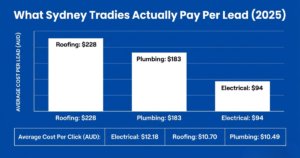
Here’s the problem. A lot of Sydney tradies see a 6 percent click-through rate and think the campaign is working. Meanwhile they’re spending $10.49 per click on plumbing keywords and $12.18 per click on electrical keywords – both well above the national average for most industries – and generating almost no booked jobs from it. The ads are getting clicks. The business isn’t getting work. There’s a very clear disconnect, and CTR has nothing useful to say about it.
Over the past 12 months, our performance marketing agency has reviewed Sydney trade ad accounts across electrical, plumbing, roofing, HVAC, and renovation services, and the same issue appears repeatedly: campaigns optimised around clicks instead of booked revenue.
The Number That Actually Pays Your Bills
Cost per lead – what it actually costs you to get one genuine enquiry – is the metric that determines whether your ad budget is working or burning.
According to 2025 benchmark data covering thousands of home services campaigns, roofing businesses are paying an average of $228 per lead through Google Ads. Plumbing sits around $183 per lead. Electrical contracting averages $94 per lead. These are not small numbers, and in Sydney – where ad costs run higher than most Australian cities due to competition – they can push even further north.
In performance marketing, even small tracking inaccuracies can distort profitability very quickly, especially in Sydney’s higher-cost suburbs. Benchmarks vary by suburb, competition level, and service type, but the broader trend across Sydney trade campaigns remains the same – businesses tracking real revenue and acquisition costs accurately are the ones scaling profitably.
Now here’s what matters. A roofing job in Sydney’s Inner West or Northern Beaches can run anywhere from $8,000 to $15,000 for a full replacement. Even at $228 per lead, if 15 percent of your leads become paying customers, your cost per acquisition is around $1,500 on a $12,000 job. That’s a return worth fighting for. But if your leads are low quality, if your tracking is wrong, or if your landing page is losing people before they ever call – your real cost per acquisition could be three or four times that, and you’d have no idea.
That’s the gap. And it’s exactly where AI in digital marketing is either helping Sydney tradies or making things worse, depending on how it’s been set up.
What AI Does With the Wrong Data
In several Sydney trade account audits completed over the past 12 months, we found conversion tracking setups inflating reported lead numbers by counting repeat callers, page interactions, and non-qualified actions as conversions. In some cases, fewer than half of the reported conversions were genuine enquiries.
Every major Google Ads account in Sydney is now running some form of automated bidding. Smart bidding strategies like Target CPA use machine learning to decide who sees your ad, what to bid, and when to show it. The system runs thousands of decisions every hour. No human can match that.
But here’s the catch. The algorithm learns from your conversion data. If your conversion tracking is recording every website visit as a lead, or counting the same phone call twice, the system is learning from completely wrong numbers. AI marketing tools are only as good as what you feed them. Bad inputs mean the algorithm optimises toward the wrong thing – and it does it at scale, 24 hours a day.
This is why working with a digital marketing agency Sydney businesses trust for accurate tracking and performance analysis is critical when scaling paid campaigns.
A Sydney HVAC business spending $4,000 a month with broken conversion tracking is not just wasting budget – it is training Google’s AI to optimise toward the wrong outcomes. When conversions are incorrectly tracking page visits, map clicks, or low-value actions instead of real enquiries, the campaign becomes less effective over time.
This is why an experienced digital marketing agency focuses heavily on accurate conversion tracking before scaling ad spend. Google’s Smart Bidding systems rely on real business signals to optimise performance. If the data is inflated or inaccurate, automated bidding strategies may prioritise activity that looks successful in reports but generates little actual revenue.
For broader business growth and compliance guidance, you can also refer to Australian Government business support and resources, which provides useful information for operating and scaling a business in Australia.
What the Right Metric Tells You
When you shift your focus from click-through rate to cost per lead and return on ad spend, the decisions become clearer.
If your Sydney plumbing campaign is spending $5,000 a month and generating 27 leads, your cost per lead is $185. If 20 percent of those leads become booked jobs, you’re acquiring a customer for $925. If your average job value is $600, you’re losing money. If your average job value is $2,400, you’re doing well. The math is that direct – but you can only run it if you’re tracking the right number. The businesses that consistently scale profitably through performance marketing are usually the ones measuring acquisition costs against actual booked revenue rather than relying on platform-reported performance metrics alone.
This is where a proper Sydney marketing agency earns its keep. Not by managing your bids, but by making sure the numbers you’re making decisions from are actually real.
Choosing the right partner is critical for growth, and you can read our blog on top digital marketing agency in Perth: what to look for in 2026 to understand exactly what businesses should evaluate before making a decision.
Four Things Sydney Tradies Should Do Right Now
Stop reporting on CTR as a success metric. It tells you about ad copy relevance. That’s useful but it’s a starting point, not a result. Your bookkeeper doesn’t care about click-through rate. Neither should you, past the point of ad quality.
Set up proper call tracking. Most trade jobs in Sydney start with a phone call. If those calls aren’t tracked as conversions inside Google Ads, your AI marketing tools don’t know they happened. The algorithm is blind to your actual business outcome. Call tracking fixes that – and it’s not expensive.
Calculate your break-even cost per lead before you touch your budget. Take your average job value, multiply by your profit margin, multiply by your close rate. That’s the most you can pay for a lead and still make money. Compare it to what you’re actually paying. That gap tells you more than a month of CTR reports.
Use your own customer data. Third-party tracking has weakened significantly over the last two years. Sydney trade businesses with a customer list – even 5,000 past clients – can build custom audiences that sharpen targeting better than any broad campaign. Your past customers and people who look like them are your highest-converting audience. Most tradies aren’t using this at all. The Sydney trade businesses scaling profitably are usually the ones measuring cost per acquisition against actual booked revenue, not platform-reported activity.
The Bottom Line
Marketing performance doesn’t live in your click-through rate. It lives in cost per lead, cost per acquisition, and actual booked jobs. Sydney’s trades market is competitive – electricians paying $12 per click, roofers at $10.70, plumbers at $10.49. At those prices, you cannot afford to optimise for the wrong number.
The businesses winning their patch of Sydney right now – the electrical contractors in Parramatta, the plumbers in Campbelltown, the roofers in the Sutherland Shire – they all know one thing the others don’t. Performance marketing success isn’t clicks. It’s cost per job acquired.
At Zentrix Technologies, we work with Sydney trade businesses who are done guessing. We go inside the account, fix what the data is actually saying, and rebuild campaigns around the number that actually matters – what a booked job costs you to acquire.
Ready to get started? Contact Zentrix Technologies today and let us support your Sydney business.
Frequently Asked Questions
Q1) Why do my Google Ads show conversions but I get very few calls?
Your campaign may be tracking the wrong actions as conversions, like page visits or map clicks instead of real calls or enquiries. Audit your conversion tracking and focus only on genuine leads.
Q2) Should Sydney trade businesses run separate campaigns for each service?
Yes. Separate campaigns help Google optimise budgets better for different job values and search intent. This usually improves lead quality and lowers cost per acquisition.
Q3) How do I know if Target CPA is actually working?
Target CPA works best when your campaign gets at least 30–50 real conversions per month. If lead volume is too low, the algorithm struggles to optimise effectively.
Q4) Why do my ads perform worse during winter in Sydney?
Seasonal demand affects many trade services. During slower months, focus your budget on urgent, high-intent searches like emergency repairs or same-day services.
Q5) Why does my ROAS look better but revenue stays the same?
Ad platforms often over-credit conversions. Measure results using actual CRM or job booking data to understand the true impact of your campaigns.
